
Low-Earth-Orbit Satellite Internet: Moving the Base Station Into the Sky
Starlink has passed eleven thousand satellites in orbit. LEO constellations cut latency to tens of milliseconds, and bring orbital debris, astronomy and capacity economics along with them.
A geostationary satellite sits 36,000 kilometres up, so a single round trip costs more than two hundred milliseconds. LEO constellations drop the altitude to around 550 kilometres and the latency to twenty or thirty milliseconds. The price is that one satellite covers a very small patch of ground, so you have to operate thousands of them at once.

Image: Starlink über dem Rathaus in Tübingen (Dktue), CC0, via Wikimedia Commons.
Why low orbit wins on latency
The floor is the speed of light. A signal going up to geostationary orbit and back costs more than two hundred milliseconds before any ground station or protocol overhead. LEO cuts that distance by a factor of more than sixty, putting round-trip latency at twenty to forty milliseconds, the same order as fixed broadband.
Coverage is the price. A satellite at 550 kilometres sees a footprint only a few hundred kilometres across and passes in minutes. Keeping a given spot served at all times needs a constellation in the thousands, plus laser links between neighbours to forward traffic, otherwise remote users can only transmit when a satellite happens to be above a ground station.
How big Starlink is now
By 2026, SpaceX has more than eleven thousand Starlink satellites in orbit, by far the largest deployment of its kind. Three parts have to work together: the satellites, the ground gateways, and the phased-array user terminal. The terminal can steer its beam to the next satellite in milliseconds, which a mechanically steered dish cannot do.
It serves a real need: ships at sea, mountain valleys, disaster zones, and anywhere with no terrestrial coverage. In those places it is not competing with fixed broadband. It is the only option.
Capacity is the hard constraint
The most misunderstood part of satellite internet is capacity. A satellite has a fixed amount of bandwidth, shared by everyone in its footprint. In a dense city the experience degrades quickly; sparsely populated areas are where it shines. It is also why it cannot replace submarine cables. The bandwidth an intercontinental backbone needs is more than a whole constellation can supply. I wrote about that division of labour in the undersea cable piece.
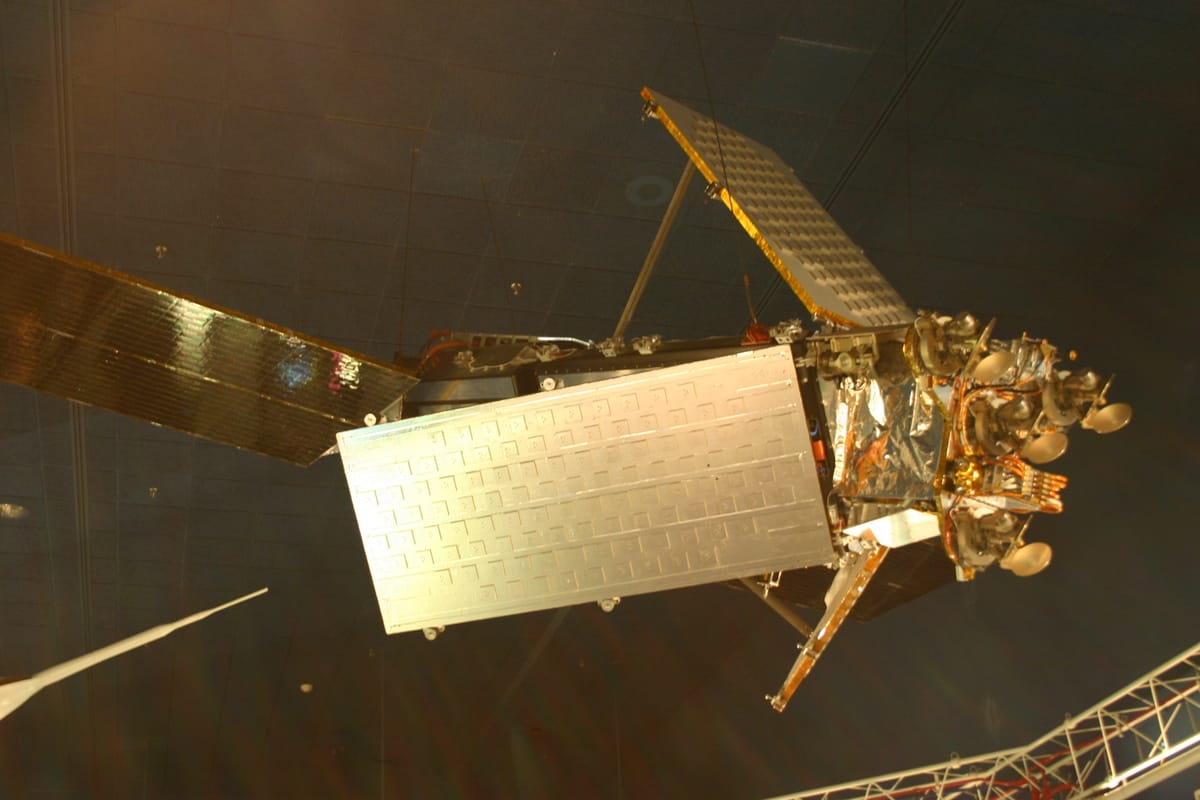
Image: Iridium satellite (Flickr user ideonexus), CC BY-SA 2.0, via Wikimedia Commons.
Iridium was the previous generation of LEO constellation, offering voice and narrowband data through sixty-odd satellites in the 1990s, and surviving into a second generation on aviation, maritime and IoT business. It proved one thing: technical feasibility was never the hard part. Finding a business model that pushes cost below what users will pay is.
Three underrated costs
Orbital debris. Low orbit is becoming the most crowded commons we have. Dead satellites, spent rocket stages and collision fragments all live there, and orbital decay at that altitude takes years to decades. More debris means more collisions, and collisions create more debris. That is the Kessler effect.
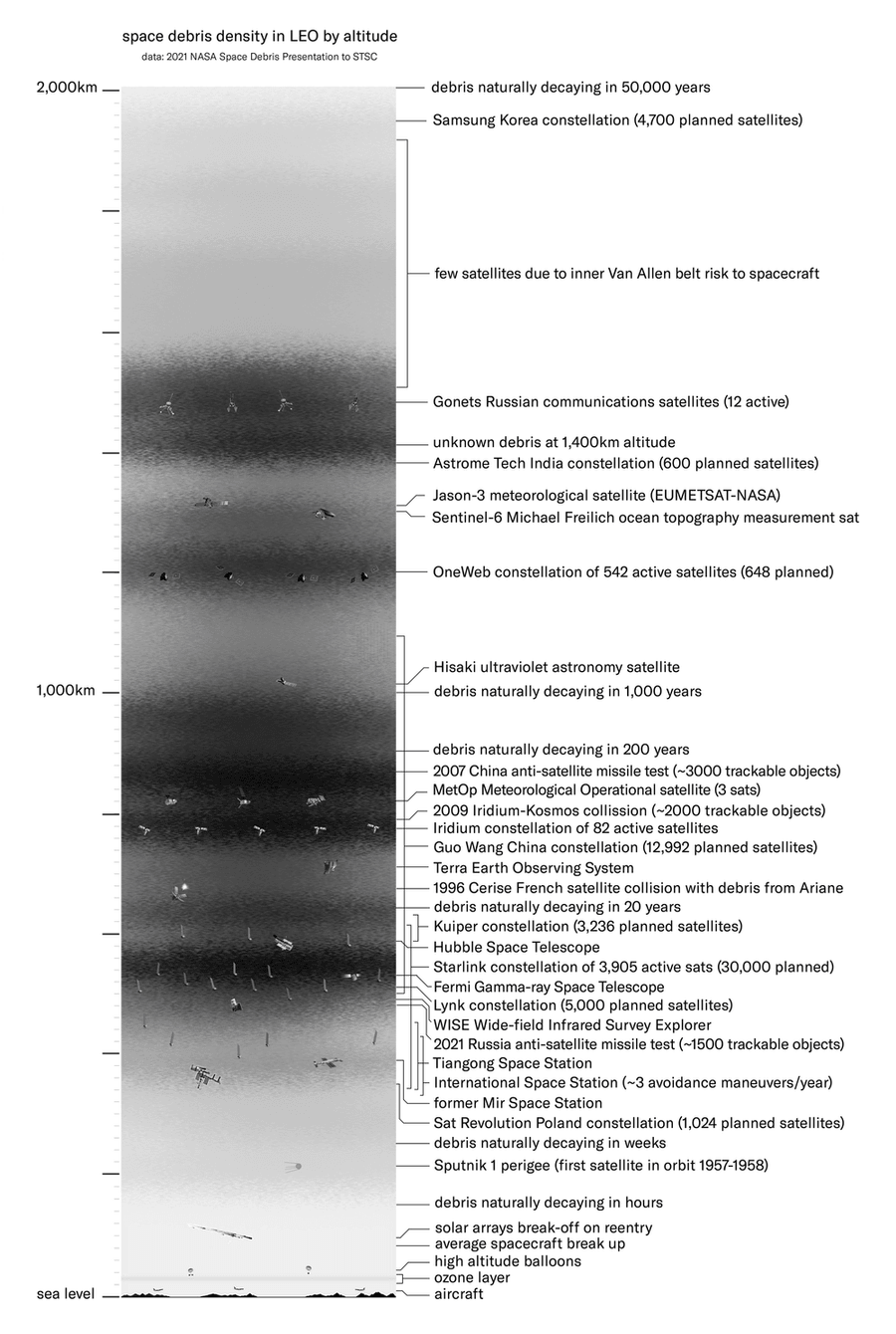
Image: Objects and debris in LEO by height (Pablo Carlos Budassi), CC BY 4.0, via Wikimedia Commons.
Astronomy. Long-exposure images pick up satellite trails as bright streaks. Astronomers and operators have built coordination mechanisms, dimming satellites and avoiding observation windows, but coordination gets harder as the count keeps rising.
Re-entry. Satellites last about five years and most burn up on re-entry. The aluminium oxide they leave in the stratosphere has an effect on ozone chemistry that is not yet settled, and it is a quantity that needs long-term monitoring.
Where I land
LEO satellite internet is the most successful space commercialisation story of the last decade, extending connectivity from terrestrial networks to anywhere with a sky. It is not a replacement for submarine cables but a complement: one handles density, the other handles coverage. What actually deserves worry is not whose market it takes, but that thousands of satellites now share one altitude band. Humanity is doing this for the first time, and orbit is not a landfill you can clean up later.
Comments
…