
Internet Exchange Points: Where Traffic Changes Hands
Your packets leave your home line, cross a few networks, and change hands at an exchange point. Here is what an IXP is, how peering differs from transit, and why exchanges set bandwidth prices.
For two networks to reach each other there are only two routes: pay an upstream, or sit down and connect directly. The first is transit, the second is peering, and the place they most often happen is a building whose name you have never heard.
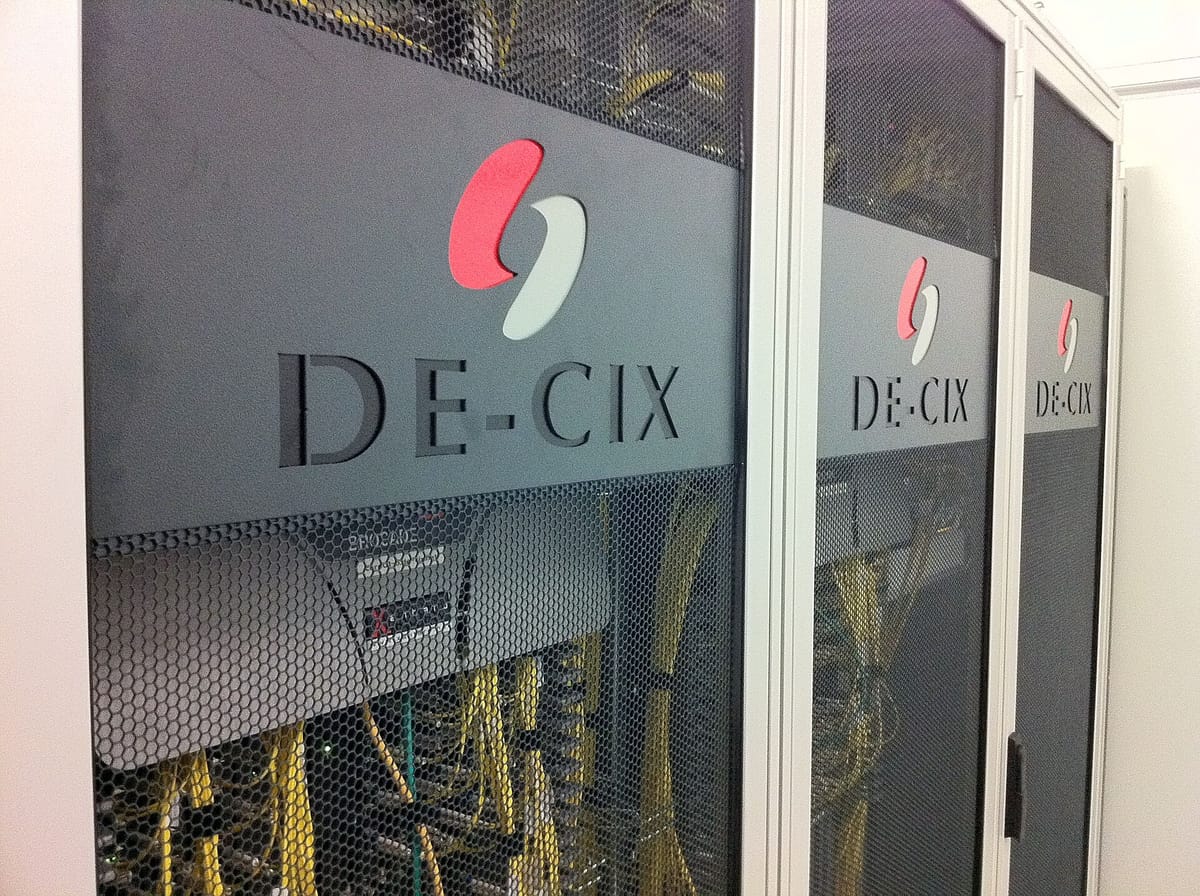
Image: DE-CIX Germany switch rack (Stefan Funke), CC BY-SA 2.0, via Wikimedia Commons.
Transit and peering
Transit is easy to understand. You pay a larger network and it forwards your traffic to the whole internet. Pricing is by bandwidth, so many dollars per month for a 10 Gbps port, and the price depends on where you sit in the topology. The further from the core, and the more you depend on someone else’s routes, the more you pay.
Peering is a different arrangement. Two networks connect a fibre at an exchange and swap routes for themselves and their own customers. It is usually settlement-free, because both sides avoid buying transit for that traffic.
Settlement-free is not charity. It has preconditions: traffic should be roughly balanced and so should coverage. A small network that mostly sends traffic outward and has almost no local users is asking to freeload on the other side’s upstream capacity, and a large network will refuse. That is why peering negotiations between content networks and carriers regularly become public arguments.
What an exchange looks like
Physically, an exchange is prosaic: a neutral data centre building, a row of racks, equipment from many networks, all patched into the same switching fabric.
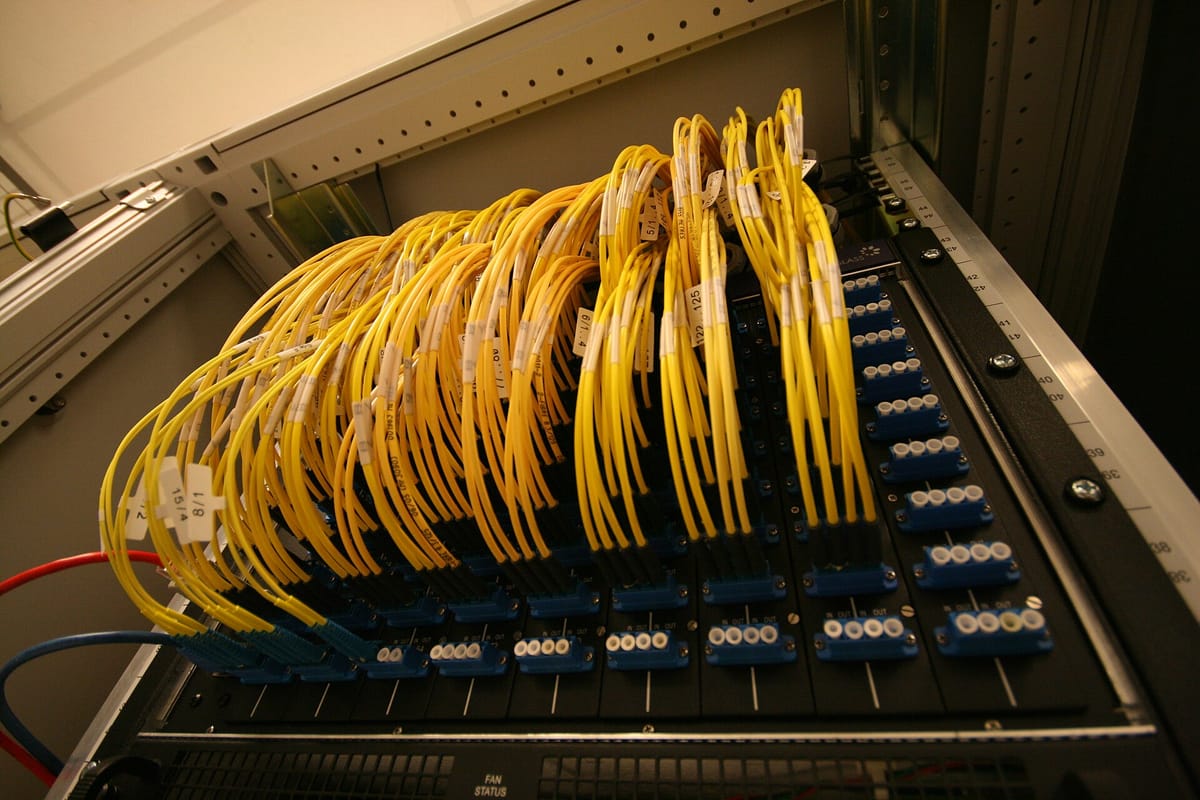
Image: AMS-IX optical patch panel (Fabienne Serriere), CC BY-SA 3.0, via Wikimedia Commons.
Participants do not run a separate cable to every other member. They exchange routes through route servers, effectively a layer-2 fabric plus a shared route reflector. Tens to thousands of networks connect, and their traffic changes hands inside the building instead of detouring through a third location.
The largest exchanges include AMS-IX in Amsterdam, DE-CIX in Frankfurt, IX.br in Brazil and LINX in London. In 2026, DE-CIX Frankfurt passed 20 Tbit/s at peak, with its sites worldwide exceeding 30 Tbit/s combined.
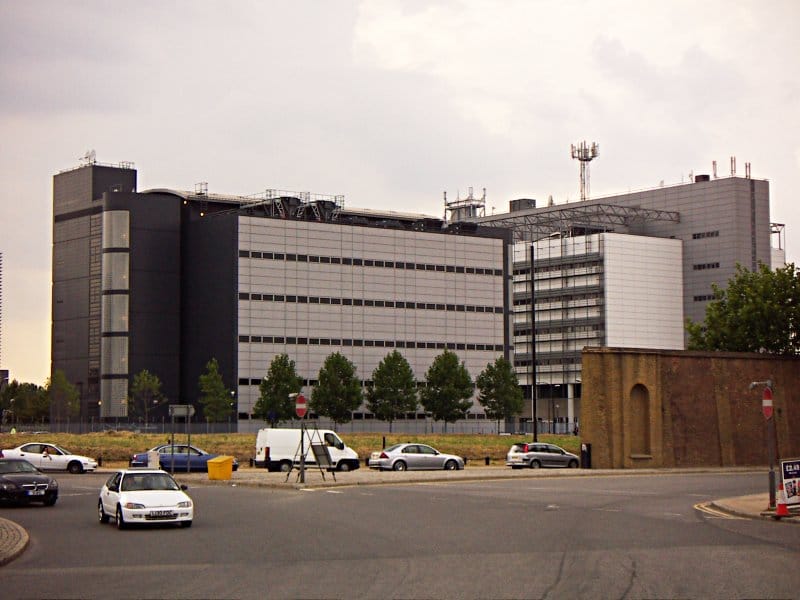
Image: Telehouse Docklands (John Arundel), CC BY-SA 3.0, via Wikimedia Commons.
Why exchanges push prices down
The value of an exchange is not technical but economic. Say two networks sit in the same city, one with content and one with users. Without a local exchange, their traffic has to detour through a third location over paid transit, so intra-city traffic crosses a border and back. An exchange removes that detour, and bandwidth cost falls with it.
The more participants, the stronger the effect. The exchange itself is neutral: it owns neither the content nor the users, only the switching, so it has no incentive to favour a side. That is why regulators often read the health of local exchanges as a proxy for how competitive a telecoms market is.
Remote peering
A small network may not qualify for a large exchange, or cannot afford cheap transit. Remote peering follows: a reseller inside the exchange extends a layer-2 VLAN to your data centre, so you stay in your own rack while logically attaching to the exchange. It spreads the price benefit to cities with no physical presence, and it decouples where you are from where you connect.
Where I land
Exchanges are the least glamorous and most price-determining part of the internet. They neither produce nor consume bandwidth. They just put networks that ought to be adjacent into the same room. What they change is not a technical metric but the bargaining structure. Once a healthy local exchange exists, an upstream carrier can no longer price on the fact that you must pass through it. That is why building an exchange is often more effective than building more backbone: it changes the rules, not the capacity.
Comments
…